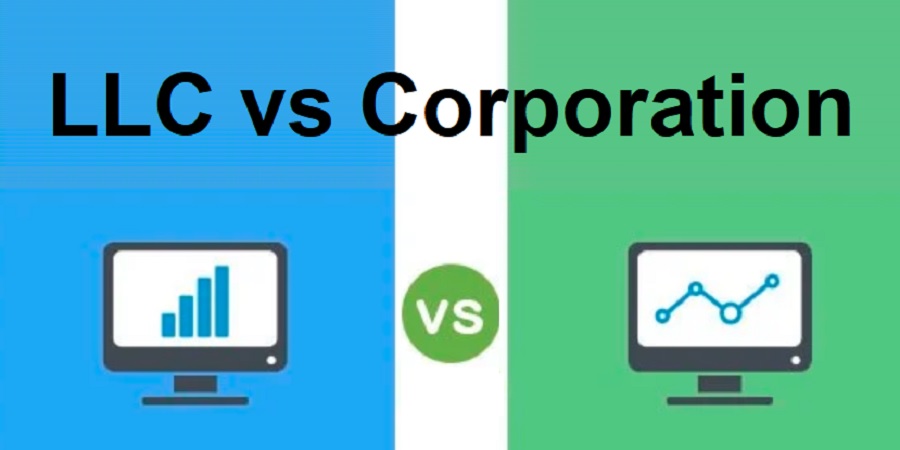
In the given article Law Ki Dunya provides the full state guideline of the LLC vs Corporation . One of the most significant choices that an entrepreneur can make in the United States is the selection of the appropriate business structure. The type of legal structure that you select initially determines the type of taxation that your business will be subjected to, the amount of personal liability you will bear and how easily you can expand in the future. This decision forms the basis of long-term success, whether you start with a small venture or intend to give it a scale-up.
On the side of liabilities, the business organization will dictate the safety of personal assets such as your home, savings, and other personal possessions in case of any lawsuits or debts against the business. Sole proprietorships are easy to establish but not that protective. The legal separation that LLCs and corporations establish shields owners against the majority of business liability. This security is paramount in the current competitive and highly regulated market.
Another significant factor that is affected by business structure is taxes. The U.S. tax system treats various entities differently and therefore, influences the amount you pay as well as the distribution of profits, every year. The appropriate structure will minimize taxation liabilities, enable deductions and provide a flexibility in the manner of reporting income. Such flexibility can have a substantial effect on the overall profitability.
What Is an Limited Liability Company (LLC)?
An LLC, or Limited Liability Company, is a loose U.S. business form that safeguards the owners, yet it is easy to manage. The personal properties of the members are usually not exposed to the liability of the business because an LLC is a separate legal entity. Small and medium businesses are fond of LLCs because of this combination of security and comfort.
Flexibility and Tax Benefits
One of the major benefits of LLC is that it is flexible as far as taxation is concerned. An LLC is pass through in default mode: profits and losses are transferred directly to personal returns of owners. This prevents the occurrence of double taxation and makes reporting easy. LLCs also have the option of other classifications which include the S or C corporation status since these are more suitable to their financial objectives.
Ease of Management
LLCs have a reputation of being easy to manage. They require less formalities compared to corporations, no required annual shareholder meetings, or extensive record keeping. The owners will be able to operate the business on their own or hire managers and provide them with complete control with minimal administration.
Example
The LLC is also popular with freelancers, consultants, or small, service-based businesses as it provides legal security, tax ease, and flexibility in running the enterprise. Those advantages allowed companies to prioritize development and customer services over the compliance inconveniences.
What Is a Corporation?
A corporation is a formal American structure that is not directly associated with its owners, known as shareholders. Such segregation offers high levels of liability protection- shareholders are not usually personally liable on the debts or the liabilities of the business. Corporations are usually selected by companies which intend to develop in the long run, intricate processes, external investment.
C‑Corporations Explained
The most prevalent one is a C-corporation which is taxed as an independent entity. The company pays a corporate income tax on the corporate profit and the shareholders on the dividends as personal tax- a case of double taxation. Nonetheless, C-Corporations can expand indefinitely, have unlimited number of shareholders, and a variety of classes of stock. This renders them appealing to big investors, venture capital firms and companies intending to go public.
S‑Corporations Explained
An S-Corporation has most of the same legal benefits as a C-Corporation, pass-through taxation. Shareholders have their individual returns in profits and losses, which are not subject to taxation twice. S-Corporations do not scale well because their eligibility criteria are limited to 100 shareholders with particular ownership requirements.
Example
Startups Tech companies and high-growth firms tend to adopt the corporate structure, particularly, C-Corporation, as it simplifies the process of raising capital and contributes to the speedy growth.
LLC vs Corporation: Key Differences
The nature of an LLC and a corporation varies in a great number of ways. The LLC is very ample and does not tie the business to the business owners, though it is informally organized. Corporation is stiffer characterized by shareholders, directors and officers under state law.
Taxation Differences
A significant difference is taxation. The taxation is pass through with LLCs where the profits and losses are reported on the returns of the owners and no taxation twice. Corporations are different: C -Corporations are taxed both on the corporate level and on the shareholder level when they pay dividends; S -Corporations also apply pass-through taxation but have limitations on ownership.
Ownership and Investment
The LLLCs have more flexibility in ownership- not many limitations on the members and profit sharing. The share structure of corporations is standardized and this is attractive to investors and makes raising capital easy particularly to high growth companies.
Compliance and Operations
LLP is also less complicated to operate, as it has fewer compliance requirements and less complex rules of operation. Formalities have to be observed more strictly by corporations: regular meetings, recordkeeping, and regulation filing. The complexity adds to the work of the administration but offers an apparent avenue of expansion and future development.
Tax Comparison: LLC vs Corporation
Tax is one that impacts on the amount of profit retained. Buildings undergo other rules in the U.S., and they yield different results according to the size and the purpose.
Pass-Through Taxation in an LLC
The pass-through taxation of LLCs implies that the business is not subject to taxation in line with federal income tax. Rather, returns to owners are in the form of profits and losses. Indicatively, when profit is received, $100,000 will be taxed at an individual rate of the owner. This saves on double taxation, and makes the filing easy- handy to small businesses.
Corporate Taxation in a Corporation
A corporate that is C-Corporation is taxed on its gains. In case the remaining profit will be the dividends, then the shareholders will be taxed again on dividends. Such a double tax will add to the total burden but can be counterbalanced by reduced corporate rates and reinvestment.
Comparing the Tax Impact
S -Corporations provide a moderation: pass-through, but with a corporate entity, but with ownership constraints. The correct option lies in the appreciation of either tax simplicity or long-term growth and reinvestment options.
Liability Protection Comparison
Both the LLCs and corporations isolate personal assets of the owners and business liabilities. The maintenance and the degree of protection are varied.
Liability Protection in an LLC
There is good asset protection and flexibility in management which is given by an LLC. Members do not have a personal liability in case the business is well maintained. Nevertheless, LLCs need to be documented and have a financial isolation. Piercing the corporate veil can occur because of misuse or mixing of finances and decreases protection.
Liability Protection in a Corporation
Corporations have strong protection, which is highly accepted by the courts due to their legal nature. The shareholders remain insulated when the firm adheres to the necessary formalities which include regular meetings, comprehensive records, and adherence to state regulations. Courts have found corporations to be credible due to their structure in disputes.
Key Differences in Legal Expectations
They both defend assets, but in the case of corporations, they must be supported by a higher level of compliance. LLCs offer comparable protection with lesser formalities, and therefore it is easier to handle legally when done properly.
Cost and Compliance Differences
The establishment and operating expenses of LLCs and corporations differ, which impact the costs of startups and the long-term liabilities.
Formation and Filing Costs
LLCs tend to be cheaper to set up with small state registration charges and less start-up. Corporations are more expensive to set up because of the complicated documents, as well as, franchise or incorporation fees charged in certain states. These initial expenses are important to small or emerging companies.
Continuing Compliance Requirements.
The ease of continued compliance is an advantage of LLCs: in the majority of states, an annual report and a small renewal fee are sufficient and the records are not extensive. The standards are tightened on corporations: annual reports, bylaws, shareholder and board minutes. These commitments increase the administrative accountability.
Record-Keeping and Legal Formalities
Basic financial records and operating agreements are the areas of concern in Limited Liability Company (LLC) recordkeeping. Company should maintain minute books, stock books and resolutions. Lack of such performance may result in punishment or disqualification of liability.
Overall Cost Impact
Corporations are said to incur higher upkeep expenses than LLCs due to greater compliance and increased filing costs. Small businesses will find LLCs less expensive, whereas corporations are justified by larger costs because of scalability and interest to investors.
Which Is Better for Small Businesses?
An LLC is generally the most suitable option in the U.S. because it protects, is easy, and cheap to the majority of small businesses. Individuals with small owners, freelancers and first-time business starters typically consider simple startup and low maintenance.
Simplicity and Flexibility
LLCs are simple to establish and operate and have fewer formalities than corporations. The possession of formal meetings and maintenance of extensive records by the owners are not a requirement, and one can concentrate on the day-to-day operations. Freelancers and alone business owners that would like to get protection without complex administration should use this flexibility.
Small Business Tax Efficiency.
Pass-through model suits small businesses that are moderately profitable. Income taxes are paid only once at the personal rate of the owner, which makes planning easy and cost-effective to manage cash flow in the early growth stages.
Lower Costs and Reduced Compliance
The formation fees and continued compliance costs are lower in LLCs. Annual reports are simple to file and the book keeping is minimal. These savings are accumulative over time to small businesses that are budget conscious.
Ideal Choice for New Entrepreneurs
Since LLCs offer protection against liability, simplicity of taxation, and ease of operation, they may sometimes be the most viable place to start a new business and gain strong roots in an environment with minimum risks.
Learn more about Business Law Compliance in the USA
Which Is Better for Startups and Growth?
Corporations are a preferred form of business organization in the United States when the startup business wants to grow fast and attract external funding. Their legal structure, shareholder-friendly ownership, and scalability are suitable to companies that need long-term expansion policies.
Investor Appeal and Stock Issuance
Corporations are allowed to issue more than one type of stock, particularly C-Corporations. This is the attraction to venture capital and angel investors. Being able to provide equity stakes would be relevant to startups that require substantial funding to grow, attract talent, and expand to new markets. On the contrary, LLCs face limitations on the ownership, which complicates the issue of stock.
Scalability and Long-Term Growth
The corporate framework encourages indefinite expansion with a uniform shareholder model. It permits a large number of investors, simple change of ownership, and even the possibility of offering to the public. These characteristics will provide startups with the legal and financial resources to grow domestically or internationally.
Tax Considerations for Growth
Corporations are taxed twice, however, most of the high growth startups tend to reinvest the profits instead of dividing them thus reducing the direct tax liability. Moreover, there are some tax advantages which corporations can utilize that will attract investors and venture capital companies.
Ideal Choice for Startups
A corporation is also credible, legally, and flexible enough to achieve high growth targets by businesses that desire to grow very fast, have large capital, and have a complex structure.
Final Verdict: LLC or Corporation?
When you have to decide between an LLC and a corporation, it will largely be based on your objectives, tax planning, and capital requirements as well as your long-term outlook. The two safeguard liability, only that they are applied in different contexts to different kinds of businesses.
Aligning with Business Goals
An LLC is usually the best option in case you desire simplicity, ease of administration, and flexibility. It fits the small business, freelance, and novice entrepreneurs that do not desire large administration challenges and require legal protection. A corporation provides the formal structure that can facilitate the growth of a startup with the desire to raise capital and expand at a high rate.
Tax Strategy Considerations
The pass-through taxation is applied in LLLCs hence the personal returns are only taxed once. Corporations (particularly C-Corporations) are subject to corporate taxation twice, but have an ability to reinvest a profit and to use corporate tax benefits, which can be an advantage to rapidly growing corporations.
Funding and Investment Needs
Corporations are light when external investment is required. The fact that they are capable of issuing various types of stock and hosting a large number of shareholders has made them appealing to venture capitalists and angel investors. LLCs are adaptable yet less appropriate to companies that must have large external capital or go public.
Planning for Future Expansion
Consider your long-term goals. The LLCs are simpler to run and economical in small-scale businesses whereas corporations allow scaled operations and well-defined legal frameworks in case of intricate expansion. Choosing to fit the structure comes with the growth path, meaning that the structure is not an obstacle to success.
Finally, the structure fits best is one that is simple, tax-effective, and has growth potential in accordance with your specific business objectives.
FAQs
1. What is the main difference between an LLC and a corporation?
LLC is flexible and taxed pass-through whereas a corporation has a formal structure that is applicable in case of substantial expansion and appeal to investors.
2. Is an LLC better than a corporation for small businesses?
Yes, the majority of small enterprises choose LLCs because of reduced expenditures, less complicated management, and taxing flexibility.
3. Which is better for taxes, LLC or corporation?
LLCs tend to favor small businesses in terms of taxation whereas corporations may favor larger companies that intend to reinvest the profits.
4. Can an LLC become a corporation later?
Yes, LLC can be transformed into a corporation with the expansion of the business.
5. Do corporations provide better liability protection than LLCs?
The two are highly protective of liability, although corporations must uphold it with stricter adherence.
6. Which structure is better for raising investors?
Corporations are more suitable in raising capital as they have the ability to issue stock.
7. Is an LLC or corporation cheaper to maintain?
Compared to corporations, LLLCs are typically less expensive to maintain and less expensive.