Civil litigation refers to the legal procedure of settling non-criminal disputes, which include breaches of contracts, property disputes, commercial disputes, claims on finances and personal rights. Civil cases instead of criminal punishments seek compensation, affirm rights or impose court orders. In the United States, these steps are referred to as non-resident civil actions when it comes to non-residents. In case your civil dispute is related to contracts or agreements, our detailed guide to contract enforcement legal charges in the USA can be useful to you. It describes the expenses regarding litigation.
Who Are NRPs?
Non-resident persons are known as NRPs which are individuals or entities that lack permanent residence in the United States but have legal interests in the country. This segment consists of foreign property owners, international investors, foreign business partners, and expatriates. Nurse practitioners, despite not living in the U.S., are entitled to initiate legal action, defend actions and impose rights in U.S. civil courts.
How the U.S. Civil Justice System Applies to Overseas Individuals
The civil justice system in the U.S. allows overseas persons to take part in legal processes through registered lawyers representing them. The NRPs are able to claim, present evidence, attend hearings remotely in most situations and have judgments of the court without being physically present.
The non-resident civil litigations are legally accessible and enforceable, because the courts have the same procedural rules concerning foreign plaintiffs and defendants as those that apply to the U.S. residents. A general explanation of how the American court system works can also be found on the official United States Courts website, which outlines court structure, jurisdiction, and litigation flow.
Overview of the Civil Litigation Steps
A civil litigation is generally a process. It starts with the legal consultation and the evaluation of the case. This is followed by pre-lawsuit measures including legal notices or demand letters. When the disagreement is not settled, the case will be proceeded to the formality of filing in court, document service, discovery, motions, hearings, settlement negotiations, and perhaps a trial. Once a judgment is made, enforcement measures might be necessary to recover damage or make a person comply.
Can Non-Residents File or Defend Civil Lawsuits in the USA?
Yes. The domestic legislation of the U.S. enables foreigners and other foreign organizations to seek the services of American courts to defend their rights, settle disputes, and to enforce their claims. The civil court procedure in the United States of America as applied to non-residents provides the same legal safeguards as the U.S. citizens but accommodates overseas litigants through procedural means.
Legal Standing of Non-Residents
The foreigners and overseas companies have the right to be heard in the civil courts of the U.S. They are able to initiate lawsuits, counterclaims, provide evidence, and demand remedies. The foreign plaintiffs and defendants have been acknowledged by the courts in the existing civil procedures and so can seek compensation, injunctions or enforcement measures. The legal standing of a dispute is determined by the legal interest of the dispute and not by the residency status.
Jurisdiction and Where a Case Can Be Filed
The issue of whether the dispute can be heard in a U.S. court is determined by jurisdiction. In case of non-residents, jurisdiction typically relies on the contract location or property location, the location of business or the place of harm. When an issue has a strong relationship with either a state or a federal court in the U.S, it can be safely heard at that court. It is important to know the foreign national court procedures and jurisdiction rules in order to file properly and be accepted.
Access to Courts and Court Procedures
U.S. courts are mostly used by non-residents, who are represented by licensed attorneys on the local level. The majority of the courts permit filing, hearings, and case management to be processed by the counsel even without the physical presence of the foreign party. Testimony, depositions and conferences can be held remotely, in most cases.
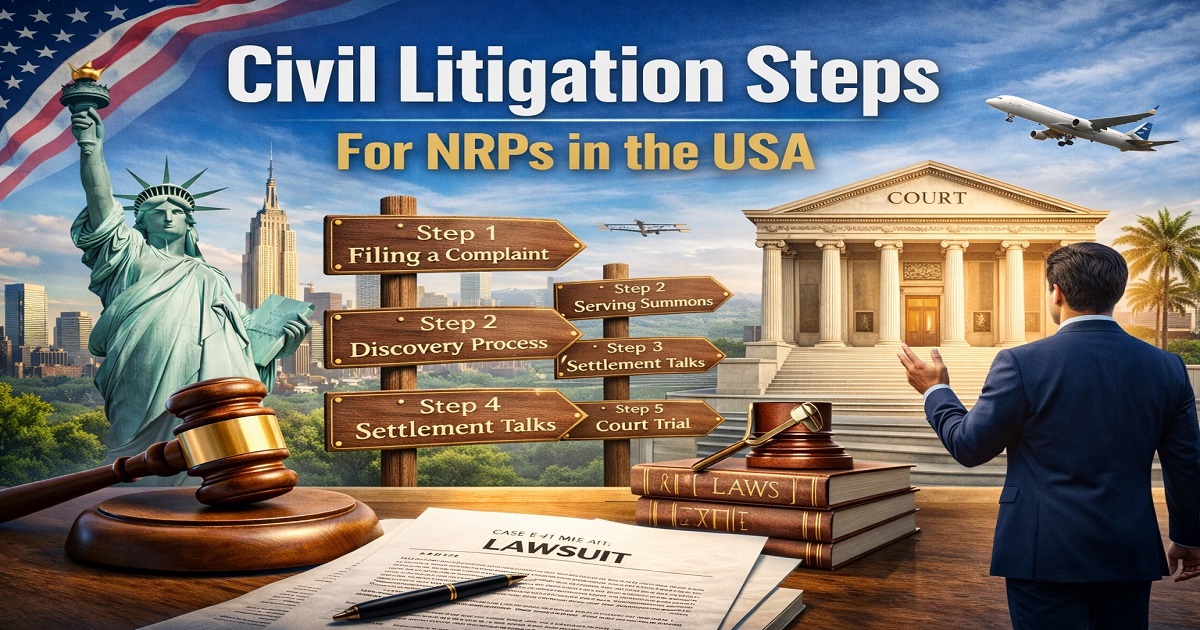
The civil court procedure of non-residents in the U.S. follows the same steps as a domestic case: filing of the complaint, documents service, discovery, motions, the settlement procedure, trial, and the enforcement of the judgment. The courts undergo common civil procedure to foreigners so as to promote fairness, due process, and accessibility of justice equally.
Civil Litigation Steps for NRPs USA (Step-by-Step Legal Process)
Step 1 – Case Evaluation and Legal Consultation
The process begins at the case level of professional review. The NRP attorney in a civil litigation case in the U.S. looks at facts, records, risks, and the potential results. This step can include examination of contracts and property records, financial evidence and communications to determine whether a valid claim or defense is found. NRPs are using international legal services to learn about jurisdiction, possible expenses, and plan. The timely assistance averts poor submissions, default of time, and avoidable litigations. Lawyers also give advice as to which is the best option between settlement, mediation or court.
Step 2 – Filing a Civil Lawsuit in the USA from Abroad
In case litigation is required, the attorney provides formal pleadings- complaint or response. The process of filing abroad follows the need to choose the suitable court depending on the jurisdiction and venue and to be precise in stating claims, facts, and remedies. This action requires a high level of adherence to the court rules. In many cases, contracts, ownerships, financial reports, sworn statements, and exhibits are required. The case is officially initiated and court schedules start as soon as filed.
Step 3 – Service of Process and Cross-Border Procedures
The other party should be formally notified, that is, to service of process after filing. In cases where the parties are abroad, cross-jurisdiction rules are observed in courts to provide adequate notice. Service can be in the form of international treaties, foreign authorities or court approved ways of delivery. Service is essential, and wrongly given notice may stay or put the case out of court.
Step 4 – Discovery, Motions, and Evidence Exchange
The discovery stage is when both parties share the information also by submitting document requests and writing questions, subpoenas, and depositions. Prior to trial, lawyers can file motions requesting the court to settle legal matters. It is the heart of the legal practice of NRPs. Lawyers collect facts, oppose assertions, defend the rights of the clients, and construct arguments. Discovery usually decides whether a case is settled or whether it is proceeded to trial.
Step 5 – Court Hearings, Trial, and Remote Appearances
Courts can conduct hearings to settle the case, control it, or even to deal with settlement. In case of no agreement, the case proceeds to trial. Physical presence is not required in most cases with NRPs. Numerous companies currently offer distance services, and foreign parties can be involved with video testimony, online hearings, and representation of an attorney. The U.S courts are guided by procedure on foreigners, so that non-residents have the opportunity to prove and refute claims, and have a fair trial.
Step 6 – Judgment, Enforcement, and Appeals
Upon trial or settlement, the court renders a decision which can take the form of money, security of contract, or other measures. Failure by the losing party to do so would then be followed by enforcement measures, including seizure of assets, liens, or court orders. In cases where assets, parties or enforcement actions are not confined to the United States, international dispute resolution will frequently involve cross-jurisdiction. An appeal can be made either side when there are claimed legal errors.
Documents Required for Civil Litigation in the USA
When attending a civil lawsuit, the right forms are required when filing or defending a case. There are procedural rules that courts may take seriously and incomplete or missing documentation may delay proceedings, undermine claims or dismiss a case. The documentation needed will be determined by the nature of the case, however, most cases will be litigated by the following main categories, which are applicable when the cases are involving the foreign courts.
Identity and Authorization Documents
The civil litigation begins with identity and legal permission. Non-resident persons tend to present passport identification, whereas foreign corporations upload business registration and ownership reports. Courts might need signed representation agreements or powers of attorney that will verify the authority of the lawyer when the attorney is representing foreign entities.
Court Pleadings and Legal Filings
The process of pleadings initiates a lawsuit and forms it. They are the first complaint or petition, and replies, and rejoinders and amended pleadings. During the case, the motions, briefs, and sworn statements are provided by parties. These records are not meant to lack any rigorous format, filing protocols and time limits. They constitute the official legal framework of the dispute.
Contracts and Transaction Records
The majority of civil conflicts are based on the written agreements and financial statements. Contracts, amendments, service agreements, purchase records, invoices, payment histories and correspondence are the documents reviewed by the courts to ascertain obligations and breaches. Such papers are used in claims of damages or enforcement.
Ownership and Property Records
In cases of litigation on property or right to assets, ownership documentation is necessary. Ownership is registered by deeds, title documents, mortgage documents, lien filings and management agreements which disclose any fraudulent transfers or restrictions. Such records are often demanded in property, inheritance and commercial property litigation.
Communication and Evidence Files
The facts of the case are supported by evidence documents. They consist of emails, letters, contracts, photographs, videos, accounting records, inspection reports and expert evaluations. In the process of discovery, hearing, and trial, the courts are guided by systematic evidence to determine credibility and liability.
Discovery and Court Procedure Documents
As the case moves on, discovery and procedural filings are required. These are formal discovery requests, written responses, subpoena, transcripts of depositions, notices of hearings, and court orders. They keep a record of the legal procedure and safeguard the procedural rights.
Service of Process and Cross-Border Records
When it comes to foreign parties, courts demand evidence to show that legal documents were duly delivered. Notice requirements were met in service records, global delivery confirmations, court approvals and documents that are compliant with treaty. These paperworks are essential to jurisdiction and due process.
Judgment, Settlement, and Enforcement Documents
Additional phases are aimed at settling cases. The legal outcomes are defined by settlement agreements, court judgments, filed enforcement, and records of appeals and facilitate recovery efforts. These are the documents that complete rights, obligations and remedies decreed by the court.
Civil Litigation Timeline for NRPs in the USA
Knowledge of the timeline assists NRPs to have realistic expectations and be financially and strategically planned. Although every case is different, the majority of civil lawsuits have a very similar pattern of steps to be undertaken. The non-resident civil court process in the U.S. may take several years or a few months, depending on the complexity of the case, workload, and the conduct of the opposing party. The federal rules of civil procedures outline the official rules concerning civil lawsuits in the U.S. federal courts. These rules are available in the Cornell Law School Legal Information Institute.
Pre-Litigation Review and Early Resolution
The timeline usually commences prior to the filing of a lawsuit. The lawyers analyze documents and evaluate the legal force, and can include formal notices or demand letters. The period may take weeks to months. Numerous conflicts are settled here, which greatly reduces the time span of the whole process and is independent of courts.
Filing and Initial Court Procedures
As soon as a lawsuit is pleaded, the courts take them up and give them case numbers. The other side is then to be formally served. In the case of NRPs or cross-border disputes, service may be delayed as there is a requirement of international notices. The process normally takes between one and three months but can take more time in case the defendant is hard to find or service has to be provided abroad.
Discovery and Evidence Exchange
Discovery is typically the most time-consuming phase. Documents are exchanged, written questions are submitted, depositions are made and expert analysis is sought. Discovery may take months or more than a year depending on the volume of evidence involved and contentions. This is prolonged by complex commercial or property cases.
Motions, Hearings, and Settlement Efforts
Lawyers can make motions to set aside legal problems or restrict the case during and after discovery. At this point, settlement talks are also encouraged by courts. The hearings, mediation, and negotiation stages may add jobs to the schedule by several months, particularly when any party objects to evidence or protocol.
Trial Preparation and Trial
In case there is no settlement, the case is taken to trial. Preparation of trial incorporates coordination of witnesses, organizing evidence and preparing of legal brief. Trials are scheduled based on the availability of dockets, a point that can lead to delays by the court. Depending on the case, the trial itself can take between one day and several weeks.
Judgment, Enforcement, and Possible Appeals
Courts make written rulings after trial and this can require weeks or months. Failure to comply on the part of the losing party attracts enforcement measures, which further increases time. The appeals may also prolong the duration by months or even years, particularly in a high-value dispute.
Why NRPs Often Experience Longer Timelines
International services of documents, cross-border evidence gathering, time zone planning, and adherence to foreign notice requirements take NRPs more time. These combine to make the civil process in the U.S. longer than the domestic cases.
Common Types of Non-Resident Civil Lawsuits in the USA
The foreign entities and non-residents often feature in civil litigation within the U.S. The legal system of the U.S. enables external parties to make claims, defend, and enforce rights in numerous sections of the law. The following are the most prevalent non-resident civil litigations and their existing place in the international dispute resolution process.
Business Disputes
The most common non-resident cases are business disputes, which encompass joint venture, shareholder, distribution, franchise, unpaid services and commercial transactions at the cross-border. Through U.S. courts, international companies are able to involve structured procedures, enforceable judgments and recognition globally.
Contract Enforcement and Breach Claims
Contract disputes are based on breaches of contracts, non-observation of obligations, non-performance of service, or misrepresentation. The non-residents usually seek contract enforcement concerning business transactions, property purchase and sale, technology or consulting. In America, contracts are interpreted by courts and damages awarded.
Property and Real Estate Litigation
Civil suits typically brought by foreign property owners and usually defended by foreign property owners concern ownership claims, title flaws, tenant claims, building issues, boundary claims, and contract claims. Such cases not only entail the knowledge of civil litigation but also property law and involve rights that are enforceable as against U.S. assets.
Inheritance and Estate Disputes
Non-residents usually participate in will contests, trust cases, probate cases, and asset recovery cases. These occur when foreign beneficiaries or heirs possess legal interests in American property. Such matters are addressed in courts through civil procedure rules and the non-residents could bring claims by an agent.
Tort and Civil Liability Claims
Non-residents may be the plaintiffs or defendants in tort cases: negligence, fraud, misrepresentation, personal injury, professional malpractice, and financial harm. These arguments overlap international dispute resolution when there is cross-border evidence or parties or enforcement.
Role of a Civil Litigation Lawyer for NRPs
An NRP requires legal representation since the U.S. civil system is characterized by the multidimensional rules of the process, a significant number of deadlines, and formal court conditions. An NRP attorney handles all phases of a case, including the assessment, planning and preparation of a case, discovery, motion, settlement negotiations and hearings and trials on behalf of an NRP. The lawyers also organize communication, protect the evidence, and defend against unfair accusations and may help enforce the judgment and create an appeal when needed. With their assistance, NRPs can easily access justice in the U.S. overseas.
Several NRPs begin legal lives by meeting with a qualified attorney. To find out how such consultations are organized and what overseas clients need to expect, you may also refer to our article on attorney consultation fees among NRPs in the USA; it will provide an idea of pricing schemes and frequently used legal service arrangements.
Remote Civil Litigation Services for Overseas Litigants
The contemporary systems enable the full involvement of the non-residents in U.S civil lawsuits without the need to travel. Electronic case management, online document filing and evidence inspection, and video conferencing allow international customers to scan documents, examine pleadings, e-sign, real-time communication. Online court filings and virtual access are encouraged in courts, and thus remote participation is feasible. NRPs that travel regularly to the U.S. usually use digital solutions. Online legal services vs in-person attorneys? we give the details of these options.
Digital Case Handling and Online Legal Management
Attorneys are formal agents, they submit pleadings, make appearances in court, negotiate and manage communication. Numerous courts have opened up virtual hearings, video depositions and remote testimony, and have provided overseas parties easier access to the process.
Legal Representation Without Physical Presence
Courts have stringent guidelines regarding filings, service, exchange of evidence and deadline. Lawyers make sure that all the procedural tasks are done properly, such as international service requirements, sworn filings, and discovery obligations, that there are no technical mistakes that may lead to delays or dismissal.
Procedural Compliance and Court Coordination
Once a case has been tried, the attorneys will still help in settlement talks, execution of judgment and appeals. They assist in asset recovery, compliance ordered by the court and post-judgment filing. Safe communication channels allow foreign customers to be informed, deliberate, and give a green light to implement measures in their overseas operations.
Cost of Civil Litigation for NRPs in the USA
The prices are quite diverse in terms of the type of dispute, court, and length of the case. The costs of attorneys, filing fees, discovery fees, expert expenses, trial preparation and enforcement actions are all part of overall costs.
Attorney Fees and Legal Representation Costs
The highest costs are normally attributed to attorney fees. Attorneys bill based on plan, pleadings, negotiation, filings, discovery, legal hearings and trial advocacy. The fees can be hourly or fixed on certain services. In the case of NRPs, cross-border coordination and cross-border service, remote communication, and compliance monitoring are also charged. Skilled lawyers work on early settlements in order to contain expenses.
Filing Fees and Court-Related Expenses
Courts impose compulsory filing costs in opening a case and filing motions. Other court expenses such as service of process, transcript fees, certification and hearing fees amount. International service is also costly because of translation, courier services, and adherence to foreign delivery processes.
Long-Term Litigation and Ongoing Case Costs
The cost of litigation increases the cost in the long run. The process of discovery, depositions, consultations with experts, motion practice, trial preparation, and enforcement actions prolongs the process and introduces the attorney time and administrative expenses. In case of appeal, expenses increase further because of vigorous preparation and representation in court.
Common Challenges NRPs Face in U.S. Civil Litigation
Transnational factors present procedural, logistical and strategic challenges which influence time and cost.
Jurisdiction Conflicts and Legal Authority Issues
When business activities, contracts and assets cut across national boundaries, it is very difficult to establish the correct jurisdiction. The jurisdictional issues may stall cases, give rise to other motions or dismissal. The key to eliminating initial difficulties is to be aware of cross-jurisdiction processes.
Evidence Transfer and International Documentation
International evidence gathering may be challenging. International standards may demand translation of contracts, business data, or witness statements, authentication, or transport. The strict admissibility rules that are set up in U.S. courts complicate evidence transfer.
Enforcement of Judgments Across Borders
The victory in a lawsuit does not mean recovery. In case the resources or defendants are located outside the U.S., they must be enforced by foreign courts or coordinated litigation. Application of cross-border judgments is complicated and may require additional litigation.
Delays, Distance, and Procedural Barriers
NRPs often have to work with longer periods because of international service and time zone scheduling as well as the review of the procedure by various authorities. Foreign service or cross-border discovery may be extended by the courts; this vastly prolongs the litigation and raises the costs.
Final Guide to Civil Litigation Steps for NRPs USA
Civil litigation provides a legal framework through which non- resident individuals can advance rights claims, solve disputes, and claim in the US. It is imperative to know the complete procedure, including case evaluation and filing, discovery, hearings, trial, judgment, and enforcement, to make informed decisions and prevent expensive errors. The system is to provide equal legal standing to the foreign parties with the rigorous procedural standards.
Successful non-resident litigation is based on professional legal support. Advanced lawyers assist NRPs with court procedures, filing, exchange of evidence and present clients at hearings and negotiations. With their help, the legal process becomes available, adherent, and enforced.
In the end, civil litigation is concerned with manoeuvring a formal legal framework with accuracy, defending rights internationally, and ending up with lawful binding results. Through proper guidance, NRPs will be sure to communicate with the U.S. civil justice system, reduce risks, and seek just resolution in a secure legal framework. If your case also involves U.S. real estate or overseas property disputes, you may benefit from reading our guide on property law resources for NRPs in the USA to better understand legal protections and dispute options.
FAQs
1. What are the civil litigation steps for NRPs in the USA?
They are case evaluation, filing, service of process, discovery, hearings, trial, and enforcement.
2. Can a non-resident file a civil lawsuit in the USA?
Yes. Non-residents have the ability to pursue and defend civil proceedings in U.S. courts that have the jurisdiction.
3. Do NRPs need a civil litigation lawyer in the USA?
Legal representation is optional but it is very much encouraged because of the complexity of the process.
4. What documents are required for NRPs civil litigation?
Identification, contracts, evidence records, court records and authorization documents.
5. Can NRPs attend U.S. civil court hearings remotely?
In many cases, yes. Courts can permit distant appearances by use of lawyers or video hearings.
6. How long does civil litigation take in the USA?
Depending on the complexity and schedules of courts, civil litigation can be months to several years.
7. What types of civil cases involve NRPs most often?
Land law cases, commercial litigation, estoppel, and the enforcement of contracts.
8. How much does civil litigation cost for NRPs in the USA?
Prices depend much and depend on court fees, lawyer rates, and the complexity of the case.